As humans we are living in a world where we are surrounded by images that can shape our decision making and create patterns to follow. In these times, with everyone having access to the online world at their fingertips, the amount of visuals, pictures, and video images can be substantial. Being in this online environment allows opportunities to make connections, create trends and change perceptions. With the presence of tools available that are centered on web 2.0, it has become easier for visuals to become more accessible. More specifically, the dependency towards web 2.0 occurred between the periods of 2000-2008. At this point in time, users looked to make use of platforms such as Facebook, Twitter and Instagram. The end goal was to foster creativity and create opportunities for those who are looking towards alternative outlets of representation. The web 2.0 phenomena has created a practice known as prosumerism. This is a practice where the content shared online can be available for others to consume. The idea of our blog is to inform teens about the various aspects of visual culture. Specifically, we want our audience to be aware of the practice of image manipulation, understand the framework centered on storytelling, and develop awareness about the features and practices reflected through visual culture such as memes and selfies.
With the dependency towards technology and social media, we have become accustomed to creating images and devoting countless hours consuming the creations of others. Specifically, with the presence of social media, we have become more saturated with images than ever before. A significant portion of our brain is centered on visual processing. This allows us as humans to process images at an incredible rate (Why Images Are So Important to Social Media, 2017). Ultimately, the use of images have become an optimal way to communicate in a world of short attention.
Captivating Ones Interest in Images
The space of social media is vast and large. This means that proper use of images can be a great way to harness ones attention. It must be noted, that the human mind is more responsive to both images and color in comparison to other types of mediums. This means the use of images can create irresistible connections with those interacting with them. More specifically, these viewpoints are reflected in Jacob Silverman’s book on social media. In Chapter 4, he states that “social media depends on … acts of recognition … the thing itself … if it is interesting or important, we claim a tenuous connection to it”. Silverman also argues that “experiences become not about … the fulfillment of those we’re with … they become about ego, demonstrating status”(2015, p.62). Ultimately, this serves as a strong message to teens navigating the social media landscape in terms of awareness. Silverman notes that adolescents may be oblivious to the fact that activity on social media yields profitable benefits to corporations in the form of information. This obsession with one’s self is reflected throughout the article “Social impact in social media”. A study is conducted to reflect how images create characterizations for users. The topic of selfies provided big revelations towards the aspects of ones ego, status and recognition. Specifically, one statistic where Google reported that over 24 billion selfies were uploaded in 2015.
Moving forward, having variety and diversity of thought can be pivotal in harnessing the attention of individuals. This concept ties into the features section reflected in module 8. This is where the usage of memes, gifs, and selfies has become more popularized in these modern times. The increased dependency towards these features can be attributed to the changing dynamics of the social media landscape. Specifically, adolescents are constantly looking for interactive and creative ways to stay connected and be entertained. In addition, there is a constant need for new information and having the ability to acquire it in quick succession. Without catering to that tendency there is a risk of losing an audience to boredom and repetition.
Image Credit: SteveCutts.com
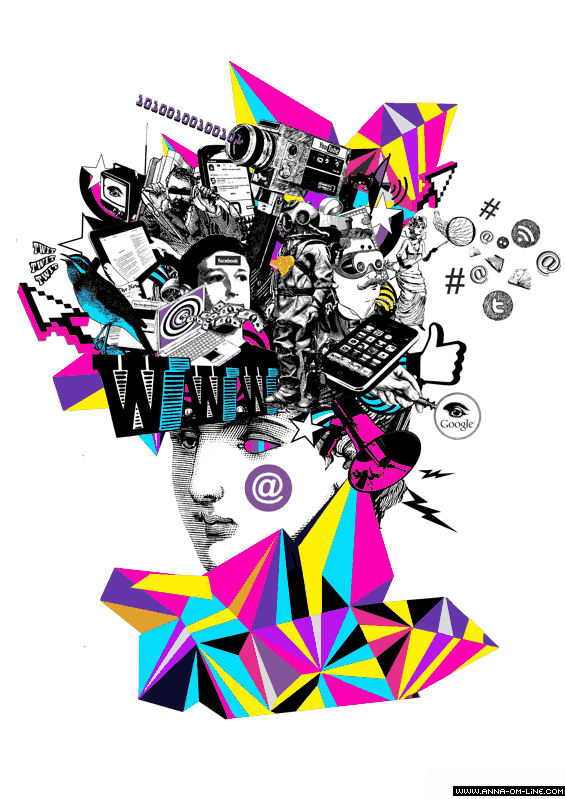
The photo above acts a representation of our society and are practices related to image consumption.
References
Silverman, J. (2016). Terms of service: social media and the price of constant connection. New York, NY: Harper Perennial.
Pulido, C. M., Redondo-Sama, G., Sordé-Martí, T., & Flecha, R. (2018). Social impact in social media: A new method to evaluate the social impact of research. Plos One, 13(8). doi: 10.1371/journal.pone.0203117
The concept and characteristics of the’ idea-meme’ are foundational in understanding the Internet meme. Coined by evolutionary biologist Richard Dawkins, ‘meme’ describes a “unit of cultural transmission” (1976, chapter 11 p. 4) with the capacity to evolve via imitation processes and cultural mutations into new forms. In “The Selfish Gene” Dawkins argues that while genetic evolution has led to brains capable of replicating sense-data, ‘biological advantage’ is inadequate in explaining cultural evolution. He notes that replicators (memes and genes), once created, tend to take over and replicate quite arbitrarily, not necessarily to our benefit. They are not, like humans, designed with foresight but rather act within their own short term, selfish advantage. In this way they create complexes of co-adapted and evolutionary stable memes as well as compete with oppositional ones. This is in a sense what makes discerning lasting and popular memes so interesting and what Jacob Silverman hints at in “Pics or It Didn’t Happen” when giving the online mediated environment attributes of monotonous, sometimes inaccessible “oral storytelling” and “secondary orality” (2015, p. 63).
Drawing upon the imitation process by which memes get copied as well as their competing for time and storage, Dawkins notes three qualities of successful ‘idea- memes’ which may give us an illustration of how memes are to be constructed:
Longevity
Do they have long or short term psychological appeal in terms of survival value?
Fecundity
How acceptable and adoptable are they by others?
& Copying Fidelity
By definition the meme as a unit is: “an entity capable of being transmitted from one brain to another… the essential basis for the idea which is held in common by all brains that understand it”(Dawkins, 1976, chapter 11 p. 4).
An illustrative example: GIF memes have condensed meaning and take up very little space and time, however Dawkins notes the problem of time as more urgent than storage.
References
Dawkins, Richard. “Memes: the new replicators.” The Selfish Gene, Oxford University Press, 1976.
Silverman, Jacob. “Pics or It Didn’t Happen.” Terms of Service: Social Media and the Price of Constant Connection., Harper, 2015.
Cultural mutations of ideas from person to person are something that poststructuralist theorists classify as inevitable in an intertextual environment. Intertextuality measures influence of outside texts on idea forms and anchors creation strictly towards imitation or remix.
For example :
1) Text placed within formal frames provides context for interpretation/creation (series, genre)
Meme genres as classified by Google..
2) Crossing boundaries of formal frames creates new forms (edutainment, infotainment or shared topics within genres or genres within mediums) (Chandler, 1994)
While intertextuality is an allusion made to another text or image, intratextuality concerns itself with “internal relations of a text” (Chandler, 1994, ‘Intertextuality p. 14’). The former should be self-evident at this point especially when considering that the internet meme is based upon external, often popular digital artifacts. The latter consists of anchorage and rhetorical orchestration.
Memes fall somewhere in between textual and visual anchorage and are most often in the ambiguous form of “Relay” (Chandler, 1994, ‘Intertextuality p. 16’) in which preferred readings rely on complementary image-text relationships. Ambiguity is part of the meme’s ESS as it allows for open interpretation and creation and so on wider adoption.
It also plays a part in the rhetorical orchestration of memes. Based on Dawkins definition, we may make the inference that the actual meme is a synecdoche which is familiar to all. In the above image the spreadable part of the meme is Willy Wonka’s essential characteristic of sarcasm. People may add this part in as context, and showcase in metonymic ways parts of their experiences/thoughts that relate to said essential phenomena. The more distanced that the metonyms are from the meme, the more metaphoric or ironic mutations become and the more popular the artifact is, the more the image guides context or metonym. This schema is mirrored in Michel Foucault’s three part sequence of the “development of writing and language” as well as Charles Sanders Pierce’s schema of: Index-> Icon->Symbol (Chandler, 1994, ‘Rhetorical Tropes p. 39’).
Poststructuralists believe that positioning within systems of language can construct personal subjectivity- it perhaps in this sense that we may begin to understand why selfies have become so infamously related to narcissism. While Manuel Castells term of ‘mass self-communication’(Ceid100, Module 8) and Danah Boyd’s optimism towards ‘worldly’ online network construction of identities (2014) present us with what is at stake, the challenge somewhat relates to the online environment perpetuating a divided sense of self .
This concept is perhaps best illustrated with analogy to Jaques Lacan’s mirror stage and the idea that children (and arguably adults) see in their mirror image a unified whole. Their reflection expresses their ego and a temporary release of frustration that emanates from their fragmented sense of self when lacking ideal physical and mental abilities. Humans often associate this reflection with their identity however this backfires because the ego “despite conscious senses to the contrary, is not a locus of autonomous agency, the seat of a free, true “I” determining its own fate…” (Johnston, 2018)
This is perhaps the aspect of online social networking or image heavy platforms that Silverman critiques when bringing to mind fixation on public perception as well as restricting egocentric tactics and conventions. He argues that what keeps us hooked is dependence on social intelligence/capital, metrics and hierarchies that lead to “calibrating of … public persona” (Silverman,2015, p.52) as well as commodification of our personhood and art.
Dawkins sentimentality towards cultural transmission as unique human phenomena and his belief that humans “hold the power to turn against [their] creators” (1976, chapter 11 p. 7) are certainly inspirational in this context. Perhaps self and textual-reflexivity is a good first step: understanding mediated realities and countering the perceived isolation inherent with “critical detachment rather than… emotional involvement” (Chandler, 1994, ‘Intertextuality p. 10’). Then we can determine whether the memes that physically inhabit our mind and environment are of ephemeral utility.
References
Boyd, D. (2015). Its complicated: the social lives of networked teens. Place of publication not identified: Yale University Press.
Who doesn’t love a good story, and with the current digital age it has become so much more accessible for each of us to tell our own stories on the web. Videos have become a popular method of communication on the internet, especially with the rise of YouTube. The video-sharing website is known as “the largest mass communication medium in the world” (Bell & Leonard 2018) with millions of videos being shared to the website each year. The terms “Youtuber”, “vlog” and “vlogger” have even been coined thanks to the website as well as provided jobs for these so called “Youtubers” for uploading content to the site and garnering millions of views and subscribers to create a community. This is due to the fact that YouTube has become that accessible platform for sharing stories through videos.
So what makes a good story if we’re going to want to tell one? We can all agree that a beginning, middle and end is necessary (Module 8) to create a plotline, have a point of conflict, climax and a resolution of some sort. Due to the casual nature of YouTube however, these rules can be bent if that’s route you’re going to take. With videos and the access we have to video editing software’s, the different elements of features we can add to our video’s assists with how the story will be produced. Whether it is a specific cut you make, a transition you add, or the audio you integrate, these elements all play a crucial role in the way audiences and viewers perceive the story being told. Thus, digital storytelling being a “complex circuit of communication” (Bell & Leonard 2018) allows viewers to have their own interpretations of the video, regardless of what the purpose behind the story is from the creator’s end.
Since we’re talking about videos as stories here, why not watch one to dissect it?
This family of five has been on YouTube for over 10 years capturing their daily lives, also known as “vlogs”. Recording every day and uploading it onto the website has clearly intrigued audiences resulting in over 1 million subscribers. After watching this vlog, its easy to point out several of the storytelling elements we discussed to help enhance their video to tell the story of their day. They have a clear introduction where their opening credits rolls in and they say “good morning” to the camera (0:17). Throughout clips of their day background audio is added and they have their own version of their ‘end credit scene’ with music rolling in and posting screenshots of comments from their audience members as their way to shine light on the community they have built. This concept of vlogs and vlogging is one example of how storytelling has become accessible. And with the devices available to us, it’s as easy as picking up our phone and pressing record to capture a video we can edit and upload online.
Frow, E. K. (2012). Drawing a line: Setting guidelines for digital image processing in scientific journal articles. Social Studies of Science, 42(3), 369–112. https://doi.org/10.1177/0306312712444303
With photography making up most of the content we face in this digital age, it is important to understand where photos have originated from. This is due to the fact that photos are a powerful communication tool for spreading knowledge. If you’ve heard the saying in passing, “a picture is worth a thousand words”, then reading this blog piece on photo manipulation will have more meaning when understanding the power behind an image. Often times, when attempting to make a photo more powerful, editors or creators turn to Photoshop editor. This infamous software program is known for image manipulation and often used to criticized photographers for the content they produce on there.
In her journal article where guidelines are emphasized when it comes to image manipulation, Emma Frow expresses her concern regarding image manipulation in the science community (Frow 2012) due to the miscommunication they provide. Her concerns come from a place where audiences from around the world are faced with manipulated images on the internet everyday (Module 8). In order to avoid fabrication of scientific data and deciding what can be used for research, guidelines defining acceptable and unacceptable images are necessary (Frow 2012). When data is misrepresented through images in the field of science, severe implications will arise in the future because we allow our actions to be impacted based on the knowledge that is distributed.
This is just one example that depicts the ethical concerns when it comes to photo manipulation, when in reality it is a reoccurring problem in more than just the science field. It makes up a large chunk of the content we come into contact with daily where the impact of the knowledge being gained from a manipulated photo is the least of our concerns. To understand this a little better, we can look at the internet as being made up of 4 layers (image 1). A single layer is dedicated to content, consisting of the video, text and images shared online. Specifically, the manipulated video, text, and images because manipulation has become a normalized concept in this digital age.
Image Created by Lida Qanun
Bell, E., & Leonard, P. (2018). Digital Organizational Storytelling on YouTube: Constructing Plausibility Through Network Protocols of Amateurism, Affinity, and Authenticity. Journal of Management Inquiry, 27(3), 339–351. https://doi.org/10.1177/1056492616660765
Zittrain, J. (2008). The future of the internet and how to stop it. New Haven, CT: Yale University Press.
This is a blog written by Lida Qanun, Michael Black and Donika Lekaj, for the purpose of our CEID 100 Fall 2019 final assignment on the topic of “Visual Culture Online”.




 Visual Culture in CEID100 Blog